Demo Day, with a Bonus

After a year and a half of steady progress on the score, we decided it was time to put together a pitch package for the show. So with the help of Elise Dewsberry at New Musicals Inc., we hired four professional singers, rented the NMI theater room and engaged Dylan Forehand to record audio and video of their performance of six songs from the musical, under Jon’s direction. Everyone stayed focused and played hard, and the day flew by. We’re still waiting for the final mixes, but were very impressed with what we heard raw. We’ll be using the results to pitch the musical at the “Biz of the Biz” conference at NMI in late July and many other places after that.

The day we were recording, I got an unexpected gift in the form of an out-of-the-blue email from the Beverly Hills Film Festival congratulating me on winning its 2022 Golden Palm grand prize for my screenplay Making Twain! We’re hoping it’s an omen of good things to come for our Mountain Lion as well.

Adventures in Covidland

2020-2022

Here’s an understatement–the theater world has not been the same for fledgling writers the past couple of years. As all theaters shut down, some permanently, the opportunities for readings and production dried up, the efforts at on-line socially distanced performance were predictably stilted, and collaboration, communication and commercialization all became more difficult, especially for someone nobody had heard of. So I’m not too embarrassed to say progress slowed down on The Last . . . Mountain Lion. And the good news is that now that we’ve all agreed that Covid is over (cough cough) and are plowing ahead, Jon Kull is pulling together the last of six songs we intend to use for our demo/pitch package for purposes of getting this thing on the map and, we hope, off the ground. We’ll be recording in Hollywood in June, and will post a few of the results on this site. Onward and upward!

Taking Shape

Events of the past year have been driving me to put a finer finish on The Very Last . . . Mountain Lion, and work to improve my playwriting skills. First, I finished a few short 10-minute plays last year and submitted them to an array of opportunities, two of which paid off. My short comedy, The Talk (clueless dad tries to make the dreaded father-son sex talk more accessible by wrapping it in rap, to son’s horror), was a finalist in the Racine Wisconsin Snowdance Comedy Festival, and after 25 sold-out February performances, won the audience-voted “Best in Snow” grand prize (out of 654 entries). And yesterday I learned that another short play of mine, The Colonoscopy and Its Many Teachings (an aging man’s reaction to the indignity of a medical probing leads to a bit of probing of his own about life, marriage and the great beyond), is one of five winners in the Durango Colorado Arts Center’s 10-Minute Play Festival, to be performed whenever the coronavirus decides it’s OK to open theaters in Colorado.

As for the Mountain Lion musical, I completed the Berkeley-based Musical Cafe’s table-reading program last December (after another table-reading and script overhaul in September), and took the invaluable feedback home where it resulted in another modest rewrite. After that second layer of varnish, I submitted the show to several venues for consideration, and am waiting for responses. The most interesting nibble so far is from Apples & Oranges Arts, a New York theatrical accelerator, which holds a semi-annual virtual shark-tank program allowing selected creative teams to pitch their musicals to theater producers and other industry insiders. I made the final round of interviews, at which they expressed strong enthusiasm for the show, but we agreed that it would benefit from adding an honest-to-God composer to the team to energize and punch up the score. They were kind enough to refer me to composers they thought might be a good fit.

But before reaching out to them, and with fingers crossed, I pitched the opportunity to the best composer I’ve ever worked with, Jon Kull. Jon is probably best known for his exceptional orchestration skills, having worked on nearly 200 TV and movie scores (recent examples–The Mandalorian, I, Robot, Black Panther and Mary Poppins Returns. See https://www.imdb.com/name/nm0003179/). But I was blown away by his composition talents on two small projects he and I collaborated on last year in L.A. And despite his busy schedule, he agreed to come in as a co-composer. I am really delighted to have him involved!

So, we now begin phase three–an in-depth reconsideration of the score, in which songs may be rethought, reconfigured, or rejected and replaced. Though this will take several months, I’m certain that his musical talent will elevate the show and be worth the wait. Stay tuned!

Progress!

Something in the corporate white-shirt world wants its occupants to suppress their emotions, speak calmly and dispassionately, leave every feather unruffled.  Under the lingering influence of that setting, the dutiful office-bound lawyer I had been for over 30 years started to write this blog entry under the title “Status Update.”  That’s what it is, but is there any more boring or noncommittal way to describe it? It’s like a 1963 newspaper going with the headline “Presidential Status Update” instead of “Kennedy Assassinated!!”

(Apparently academia has the same penchant for deadening expression–I recently “helped” my daughter rewrite a psychology research report, the primary objective of which was to put all sentences in the passive form so nobody could tell who actually ran the tests, reached the conclusions or wrote the damn paper–“The effects of introducing anthropomorphism to promotional materials were tested . . . ” “The following tentative conclusions were reached . . .” “Suppression of original thought and vivid expression was successfully accomplished . . .”  Mamby with a pamby chaser.)

So instead, let me dare to characterize the last year’s adventures as Progress!, and show some enthusiasm about it.  I find that enthusiasm, self-generated and self-directed, is about the only antidote to the deafening silence that greets the early-stage and infrequent blogger (clicking on your own blog a few times to register some views can only go so far). I intend to blog more regularly now, since I retired from the law practice this year and am starting to find time for self-indulgence.

New Musicals, Inc. in Los Angeles runs several programs for fledgling writers and composers, and I’ve now completed three of them.  The first was a one-on-one tutorial last summer about how to pitch and promote a musical. It was useful, and forced me to prepare marketing materials and think in terms of where my work could be commercially presented.   Scott Guy was a bright, knowledgeable and enthusiastic coach.  I then attended their annual “Biz of the Biz” conference, at which industry insiders talk about how to get going in the business, what separates the pros from the amateurs, and where the action is.  I took a lot of notes, shook a lot of hands and came away energized, although I haven’t to date realized any concrete opportunities as a result.  But that was mostly because instead, my spare time (I was still a full time lawyer) was taken up with the third and by far most demanding NMI program, their “core curriculum”–about half a year of very structured collaborative musical-writing projects, coupled with homework-intensive learning labs. Most of the work was submitted electronically and group sessions could be attended remotely via Zoom. Very convenient for me in the Bay Area, although something is always lost in the video-conference translation–and it’s usually the ability to hear much. My biggest challenge with the long video sessions (sometimes 8 hours) was trying to stay mindful of the fact that I was on camera (we were each displayed in our own Brady-Bunch video boxes) unless I elected to stop my video feed, which I sensed was frowned upon because you could slip out unnoticed and watch Netflix for an hour–not that that ever occurred to me.  So I will now confess that, on camera, I (i) slurped and dribbled soup (ii) picked my nose at least once, and possibly more, and (iii) took at least a 45-minute nap, during which my iPhone sat flat on my desk and transmitted the lazy circles of my ceiling fan. I only hope that the other video participants were similarly engaged and didn’t notice. We’re now working on the culmination of the core curriculum program–each collaboration team has written an original 15-minute musical that will be presented by a professional cast directed by NMI in three shows in July.

I’ve learned so much as a result of these activities–the nitty gritty details of musical theater script-writing, lyric-writing and composing, the formatting of scripts, scores and integrated script/scores, and the obscure terms for all sorts of things I did not think I needed to have obscure terms for.  For instance, music in musicals can be divided into music originated from a source within the piece’s world (dancing to a song on a jukebox or an onstage mom singing a lullaby to an onstage baby) versus songs that are sung more or less to the audience.  The first is called “diegetic” music, and I guess the second is called “not diegetic” music.  BTW, when an off-stage mom sings to an off-stage baby at a play, that ‘s just called “being a rude A-hole.” There’s a word for when a syllable is sung over more than one note–that’s a “melisma” and my instructors may have confused it with “melanoma” because they heaped scorn on it whenever it happened. I’m not so clear why “Don’t You Worry Bout a Thing” isn’t great, melisma and all. There are also tons of terms for different metered feet (a la Shakespeare’s iambic pentameter) but, like so many rarely needed or used facts these days, there is absolutely no reason to learn them as long as your smart phone is within reach.

In the course of taking the course, I reworked the Last Mountain Lion, reformatted  the script and score and wrote a couple more songs.  Feeling cocky about the improvements and my newfound smarts, I submitted the show for a table reading by Musical Cafe,  a nonprofit in Berkeley dedicated to helping Bay Area creatives develop musical shows (God I love the Bay Area!).  They selected the show and provided a space with four actors and a dramaturg to have an unrehearsed, first-impression reading–no songs, just lyrics read with the script.  It was exciting and rewarding to finally hear what I had been working on for roughly a decade come to (limited) life.  The actors were good and got laughs where I wasn’t expecting them, brought out reactions I was hoping for, and made me feel this whole thing just might be possible.  A week later, one of the actors requested a few song demos, and when she heard them (posted elsewhere on this site), more or less commanded me to send them to the entire board of the Musical Cafe as an introduction and for consideration in their Next Stages program, which is a more elaborate reading, review and development process conducted in the fall.  I am putting finishing touches on my application today, and hoping Next Stages will be the next chapter.

I’ll let you know what happens.

The Infamous, Elusive Pennsylvania Mountain Lion

Eastern-Cougar

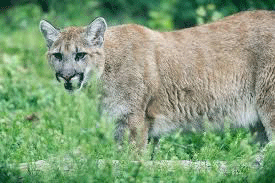
There was a time when mountain lions ranged all across the North American continent, sheltered by nearly continuous forests, feasting on uncountable deer, antelope and smaller prey.  Then the Europeans arrived, claiming farmlands from forest, becoming the dominant predator of game animals, and hunting, trapping and shooting mountain lions to protect livestock, and for sport. As a result, the cougar, once the most widely distributed land mammal in the Western Hemisphere, can now be found in only about one-third of its original range.  And it was only this year, 2018, that the Eastern cougar, a distinct subspecies that once roamed all states east of the Mississippi, was declared extinct and removed from the endangered species list.

The last officially confirmed identification of an Eastern cougar occurred in 1938, but rural residents and outdoors enthusiasts in Pennsylvania and elsewhere in the eastern states have sworn over and over again to have seen, heard or tracked mountain lions. Over 10,000 such encounters have been reported since the 1960s.  Most assume that these encounters were either faked, were with other species (e.g., bobcat, dog, coyote), or with western cougars trekking east, which has occasionally been documented.  Some speculate that the government has reasons not to acknowledge survivors of a highly endangered species–the dilemma of either offering potentially unpopular protection to a feared predator, or being guilty of aiding its extinction.

But regardless of the causes of the reports, it is remarkable how hard it has been to suppress the romantic and persistent notion that somewhere in the remaining patches of northeastern wild, a stealthy spirit from the past continues to elude human contact and eke out its survival.  This is the stuff of time-honored legends, proud local tradition, and now, a pretty entertaining musical comedy.


Off to L.A.

This is the first post of what I hope are many chronicling the progress of The Very Last, One and Only Highly Endangered Mountain Lion in Pennsylvania, a new musical comedy I’m hoping to bring to life in the next year or two.  I’m heading Sunday to the New Musical, Inc. “Business of the Business” conference, to try out my pitch on several producers and artistic directors, and to rub elbows with writers and performers further along in this process.  This is the official beginning of a quest that really started over ten years ago with the first song, but has not left my studio/office until now.  Fourteen songs, ten years and countless script drafts later, the show is complete (though very likely to change), and I’m ready to enlist the help of others and try to get the show off the ground.

NMI’s conference runs three days, but I am officiating at my best friend’s wedding tonight (Saturday) after entertaining wedding guests all day, and will be hopping on a plane late to be in LA in the morning, presumably awake and functioning for the pitch sessions. I have about 8 hours of Sunday in a room full of folks with serious chops producing musicals, to meet who I can and hope to intrigue some of them into taking a look at the show.  I’m approaching this as a golden opportunity to learn from everyone . . . water, meet sponge!  My intention is to show intention–I will be developing this play and would love some help.  I’ll report back here on what happens.

I should be clear that I have had some help already–in preparation for the conference, I enrolled in a 5-hour pitch boot camp taught by Scott Guy of NMI, who has been immensely helpful with critiques, encouragement and sage advice. Not only that, he’s a genuinely nice guy–giving me hope that the showbiz stereotypes in my head may not be entirely accurate.  We’ll start to find out tomorrow!

Like many Californians experiencing the odd vacuum of historical culture and consequence that is the West Coast suburban landscape, my wife and I once took our school-aged kids on a tour of some historic spots in the Eastern US, including a stopover in Gettysburg on our way to DC.  I had just bought an early model GPS device, with the big suction cup to stick it on the dashboard, for the trip. I made the mistake of giving it to my wife for her birthday shortly before the trip, and she has ever since accused me of buying gadgets largely for myself and giving them to her.  (Tip to Husbands: If you must buy her a gadget, (i) make sure it is something you have no interest in using and can’t derive any obvious benefit from her using (a salad spinner or vegetable spiralizer is a good bet) and (ii) get her something else that she actually wants.)

I asked it to take us to the Pennsylvania state capitol, in Harrisburg, which I was proud to remember from 5th grade, when Mr. Seline would test our state capitol knowledge with flash cards, and release us to lunch only when we got them all right.  Pennsylvania, Missouri (Jefferson City) and Kentucky (Frankfurt) were the typical stumpers, except when it was poor dumb Bill Waterman’s turn, for whom even recalling Sacramento was a crapshoot.

Anyway, we tapped Harrisburg into the GPS 1.0 while still in Gettysburg, just a few miles away, but somehow the device drew a blank (and later on the trip delivered us not to our hotel but to a homeless shelter).  I then got out the regional map of the whole mid-Atlantic region, which we had bought at a gas station as our hedge against new technology, only to discover that Harrisburg was not big enough to register as a city there either.  Determined to live the cliche, I was for setting out on the main highway and grokking our way along watching road signs,  but my wife insisted that we stop and ask directions–which got us on the right road.

We visited Harrisburg, which we declared a nice town that could use some sprucing up.  We saw the state capitol, had lunch by the river that runs through town, and headed on our way.

I note all this only because Harrisburg has a prominent place in the musical, as the promised land, the shining city, the Oz of Lester’s misguided quest.  It even gets its own song, inspired by our experience: Oh Harrisburg?

Good company in a journey makes the way seem shorter. — Izaak Walton

Pennsylvania_State_Capitol